
Storm Damage Tree Cleanup in Spartanburg, SC
A pine across the roof, limbs hanging over the driveway, a yard buried in debris, or trees that survived the last storm but no longer look right. We clear storm-damaged trees around Spartanburg homes, separate the debris the county will take from what it won’t, and tell you honestly which damaged trees can stay.
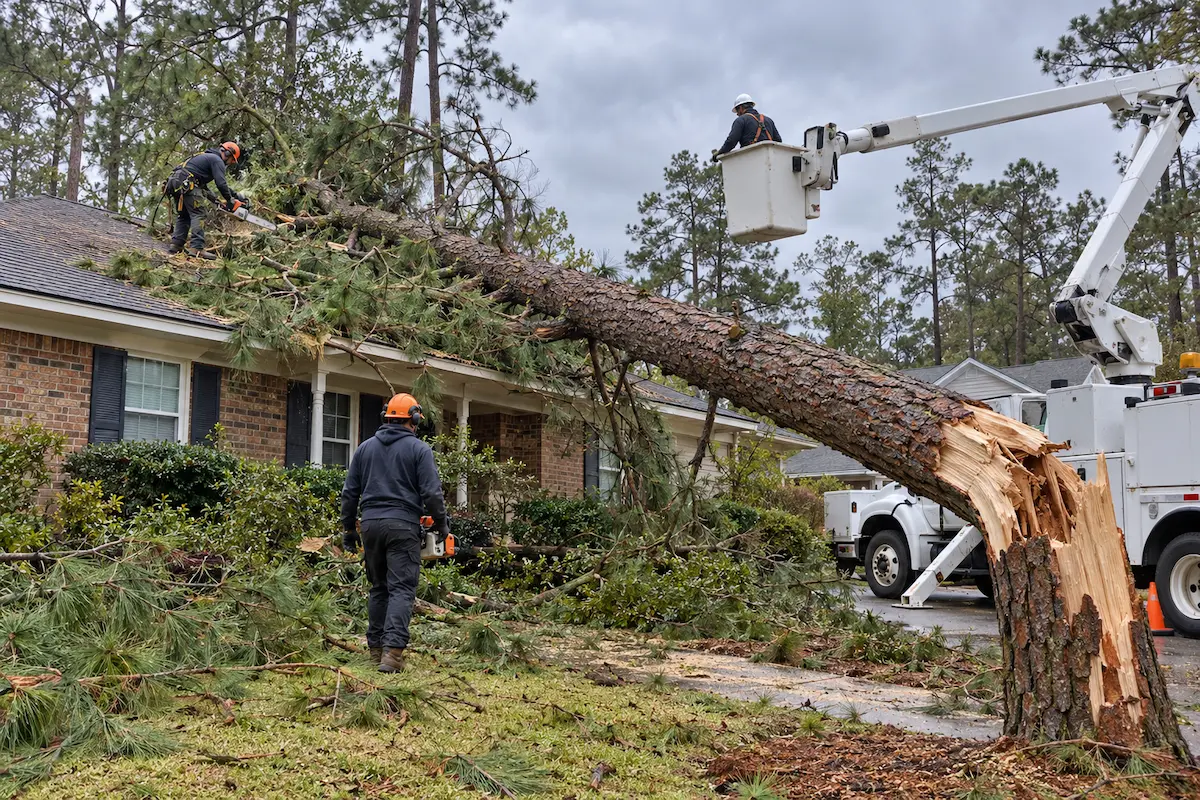
The first hour
A tree just came down. Do these things in this order.
Most injuries after a storm happen during cleanup, not during the storm. A tree lying on a roof or a fence is often under tension, and a cut in the wrong place can make the trunk spring or roll.
If anyone is hurt or a tree is on a house with people inside and the structure looks unstable, call 911 first.
- Stay away from any wire the tree touches. Treat every downed or sagging line as live and report it to your power company. A line touching a branch can energize the whole tree.
- Get people and pets out of rooms under the tree. A limb resting on a roof can shift as rain soaks the canopy.
- Take photos before anything is moved. Wide shots of the tree, the damage to the house, fence, car or shed, and close-ups. Your insurer will ask for them.
- Do not cut the tree off the roof yourself. Trunks under load can kick back. This is the part we handle with rigging and controlled cuts.
- Call us with the address and what the tree hit. We tell you what can wait and what cannot. If the hazard is immediate, see our emergency tree removal service.
What Helene taught us
Spartanburg has seen what a wind storm does to big trees
Helene reached the Upstate on September 27, 2024. By late February 2025, Spartanburg County reported having collected 1 million cubic yards of storm debris, most of it ground into mulch at temporary debris sites. The cleanup took months, and crews returned for stumps and root balls last.
Soaked ground, then wind
Days of rain before the wind left roots sitting in saturated soil. Trees that had stood for decades tipped over with the root plate still attached. When the soil is soft, a healthy-looking tree can fail at the roots instead of the trunk.
Some species fail more
Clemson’s Home & Garden Information Center rates water oaks, Bradford pears and maples as less wind-resistant, and loblolly pine as medium-low. Those are among the most common yard trees in Spartanburg neighborhoods.
Damage that shows up later
Cracked unions, broken limbs lodged high in the canopy, torn roots and bark that starts to slough off can take one or two seasons to show. A tree that “made it” through a storm is not always a tree that will make it through the next one.
Keep, prune or remove
How we decide what happens to a storm-damaged tree
Not every damaged tree needs to come down. Our job is to tell you which ones can be saved with pruning, which need watching, and which are a real risk to the house.
Risk to the house
- Trunk split or snapped
- Root plate lifting, soil cracked or heaving
- Most of the live crown gone
- Leaning toward the house after the storm
Damaged but stable
- A few broken limbs, trunk sound
- Hangers caught in the canopy
- One side of the crown thinned
- Bark wounds that need watching
Cosmetic damage
- Small twigs and leaves down
- Old lean that has not moved
- Roots and soil undisturbed
- Clean breaks on small branches
Not sure whether a leaning tree is dangerous? Our guide on a leaning tree after a storm explains what to look for at the base.
Debris
Where storm debris goes in Spartanburg
After a declared disaster, the county and the city may run special curbside collection with their own deadlines and rules. After Helene, residents were asked to place storm debris at the right-of-way by a set date. Outside those events, normal collection rules apply, and large logs and stumps are rarely picked up at the curb.
When we clean up, we tell you up front what we haul away and what we cut to a size you can leave for collection, so you can choose the cheaper option when one exists. Our tree debris guide for Spartanburg covers what happens to limbs, logs and wood chips.
- We cut the tree off the structure first, then work on the rest at ground level.
- We separate logs, brush and chips so the cleanup matches what you want to keep or get rid of.
- Stumps can wait. After a big storm, stump grinding is usually a second visit once the urgent work is done; see stump grinding.
- Firewood: if you want the wood, tell us before we start so we cut it to length.
Insurance
Storm damage, insurance and the estimate
Every policy is different, so we never promise what your insurer will pay. What we can do is make the claim easier with clear documentation.
What usually matters to the insurer
Whether the tree hit a covered structure such as the house, a detached garage or a fence, and whether it fell because of the storm rather than long-standing decay. Many policies also set a cap on tree removal and debris. Read the section on trees in your own policy or ask your agent.
What we give you
A written estimate that separates removing the tree from the structure, removing the rest of the tree, and debris and stump work, plus photos before and after. That split is what adjusters usually want to see.
For price ranges by tree size and access, see our tree removal cost guide for Spartanburg.
Where we work
Storm cleanup across Spartanburg County
We work in the city of Spartanburg and across the county, including Boiling Springs and Greer. Before working near power lines, read what to know before tree work in Spartanburg.
Questions
Storm cleanup questions
Is storm damage cleanup the same as emergency tree removal?
Not quite. Emergency removal deals with the immediate hazard, like a tree on a roof or blocking the only driveway. Storm cleanup is everything after: the rest of the tree, the debris, hanging limbs and the damaged trees that are still standing.
Should I remove a tree that survived the storm but lost big limbs?
Not always. If the trunk is sound, the roots are undisturbed and most of the live crown remains, pruning the broken limbs is often enough. If the root plate lifted, the trunk cracked or most of the crown is gone, removal is usually the safer choice.
Will my insurance pay for tree removal after a storm?
It depends on your policy. Coverage often applies when a tree damages a covered structure, and many policies cap tree removal and debris costs. We give you a written estimate and photos so you can file the claim.
Will Spartanburg County pick up my storm debris?
After major storms the county and the city have run special curbside collection with their own deadlines and rules, as they did after Helene. Outside those events, normal collection rules apply. We tell you what we haul and what you can leave at the curb.
How long after a storm should I check my trees?
Right away for anything hanging or leaning, then again over the next season. Cracks, decay and root damage from a storm can take months to show.
Storm damage on your property?
Call with the address and what the tree hit. We tell you what can wait and what cannot.