
Is My Leaning Tree Dangerous?
A tree that started leaning during or after a storm is far more dangerous than one that has leaned for years. The quickest check is at the base, on the side opposite the lean: if the soil there is lifted, cracked or soft, the roots are failing and the tree should be treated as an emergency.
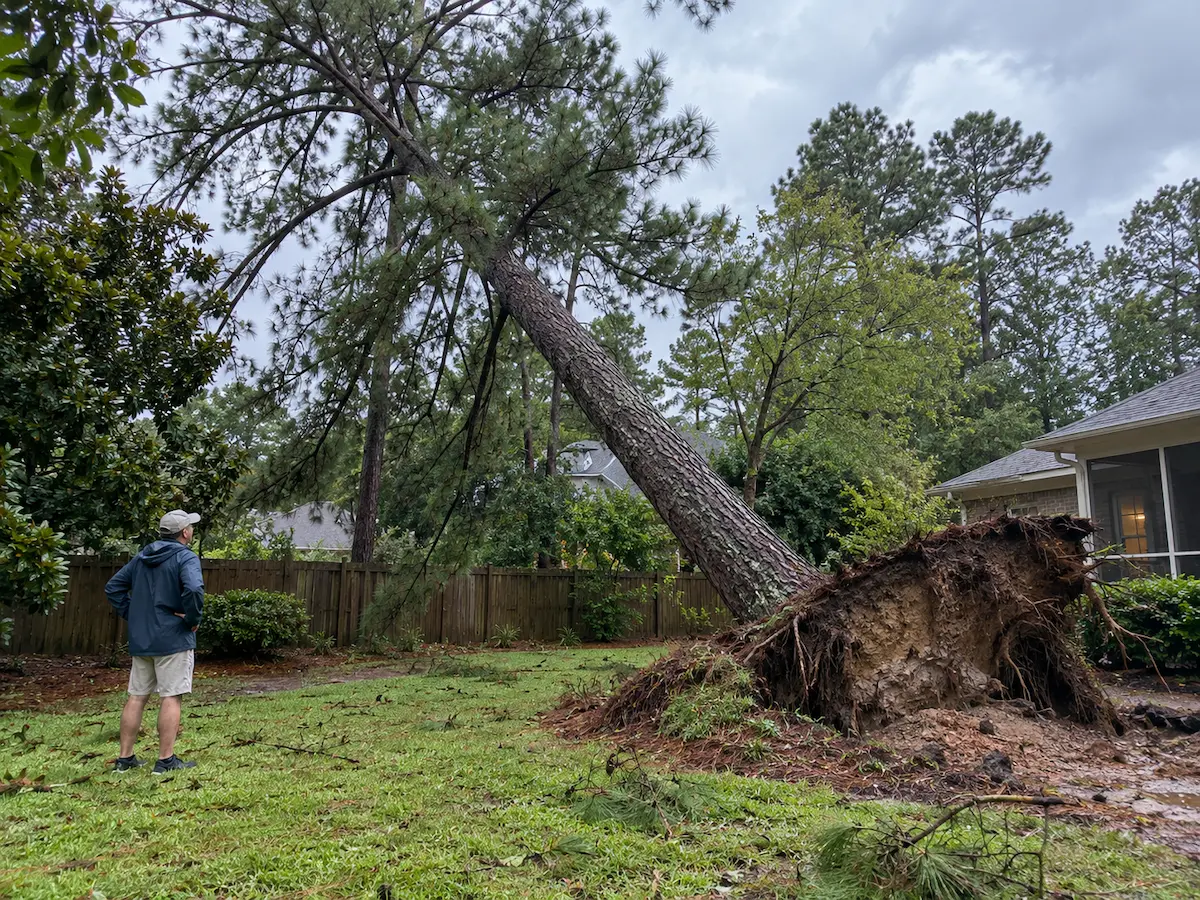
New lean or old lean
The question that matters most: when did it start leaning?
Plenty of trees grow at an angle for decades and are perfectly stable. Trees grow toward light, and over the years the top straightens back toward vertical. A lean that appeared after a storm is a different story: it means something at the roots or the trunk has moved.
Old, self-correcting lean
The trunk leans but the top of the tree curves back up toward the sky, the lean has looked the same in old photos, and the ground at the base is flat and firm. Storm-damage guidance from the North Carolina Forest Service treats this kind of lean as low risk when the root zone shows no cracking or lifting.
New lean after a storm
The tree was straight last week. The whole trunk is tilted, the top has not had time to correct, and the ground on the far side of the lean may be raised. That pattern means the root plate has started to pull out of the soil, and the next strong wind or heavy rain can finish the job.
5-minute check
Walk around the tree and look for these signs
Stay out of the fall zone while you look: a distance at least equal to the height of the tree, in the direction it leans. Do not climb on the root plate and never stand under the lean.
Do this check from the side opposite the lean, where the roots are being pulled.
- Raised soil or a mound at the base, opposite the lean.
- Cracks in the ground running around the trunk, especially next to a mound.
- Soil that feels soft or moves when you step near it or when the wind blows.
- Roots showing or snapped on the side away from the lean.
- A lean of about 30 degrees or more, the level the NC Forest Service guidance flags for removal.
- Cracks or splits in the trunk, or bark peeling away on the underside of the lean.
What to do next
Three outcomes, three different calls
Lean is new and the soil moved
Keep people, pets and cars out of the fall zone and call us the same day. If the tree is leaning toward the house or onto power lines, treat it as an emergency removal.
Lean is new, soil looks firm
The trunk may have shifted without lifting the roots yet, or the damage may be in the trunk. Have it inspected before the next storm; do not wait for it to get worse.
Old lean, nothing changed
Take a dated photo from a fixed spot and compare after every big storm. If the angle changes or the ground cracks, call us.
Upstate trees
Why tall pines lean after storms in Spartanburg
Loblolly pines are everywhere along Spartanburg property lines, and Clemson’s Home & Garden Information Center rates them only medium-low for wind resistance. Their tall, top-heavy crowns catch wind far above the roofline, and when the clay soils of the Upstate are saturated after days of rain, the roots lose grip.
That is what made Helene so damaging in September 2024: rain first, then wind. Many trees did not snap; they tipped over with the root ball attached. A pine that started leaning during that storm, or any storm since, deserves a close look at its base.
Water oaks and maples, also common in older neighborhoods, are rated less wind-resistant by Clemson and tend to fail at weak branch unions as well as at the roots.
Can it be saved?
Straightening a leaning tree: when it works and when it does not
Small, young trees that tipped in a storm can sometimes be pulled back upright and staked while their roots re-establish. A mature tree whose root plate has lifted cannot be straightened safely: the roots that held it are torn, and pulling it back does not reattach them. For large trees, the honest answer is usually removal, and the earlier it is done, the safer and simpler the job.
Questions
Leaning tree questions
How do I know if a leaning tree is going to fall?
Look at the base on the side opposite the lean. Raised or mounded soil, cracks in the ground, soft soil that moves, or exposed and broken roots mean the root plate is failing. A lean that appeared after a storm is a warning sign in itself.
Is a tree that has always leaned dangerous?
Usually not, if the top has grown back toward vertical and the ground at the base is firm and undisturbed. Take dated photos and check again after big storms.
How much lean is too much for a tree?
Storm-damage guidance from the North Carolina Forest Service recommends removal for trees leaning about 30 degrees or more after a storm. A smaller new lean with soil movement at the base can be just as dangerous.
Can a leaning tree be straightened?
Small young trees can sometimes be pulled upright and staked. A mature tree whose root plate has lifted cannot be straightened safely, because the torn roots will not reattach.
Who pays if my neighbor’s leaning tree falls on my house?
That depends on insurance and on whether the tree was known to be unsafe. If a neighbor’s tree has started leaning toward your home, tell them in writing and keep a copy; ask your insurer how it handles it.
A tree started leaning in Spartanburg?
Send us a photo of the base and call. We tell you if it can wait.